ESCMIDグローバル2025:drive-AMSのポスターが欧州全域でのAMS教育の具体的な効果を強調

ESCMIDグローバル2025会議(ウィーン、4月11~15日)において、drive-AMSコンソーシアムは、EU全域を対象とした革新的な抗菌薬スチュワードシップ(AMS)プロジェクトの主な成果を発表した。データ駆動型の行動変容アプローチを用いた欧州における病院での抗菌薬スチュワードシップの実施」と題されたポスターでは、プロジェクトの最初の2年間から得られた刺激的な成果が紹介された。.

Using a cascaded training-of-trainers (ToT) model, the drive-AMS programme reached AMS teams in 43 hospitals across Greece, Lithuania, Portugal, and Romania. The approach combined baseline data from the Global Point Prevalence Survey (Global-PPS), immersive courses on implementation science to improve antibiotic use, and ongoing support during project execution via the SPICE expert registry.

Strong evaluation scores
A total of 211 healthcare professionals engaged in drive-AMS activities, including 34 future trainers and 177 participants in local co-courses. Across all sites, 40 baseline Global-PPS surveys were conducted. Nearly half the participants completed the course evaluation, giving it average scores ranging from 9.3 to 9.9 out of 10. Respondents praised the practical structure, multidisciplinary format, and focus on behaviour change—though the latter was also noted as particularly challenging.

From training to tangible change
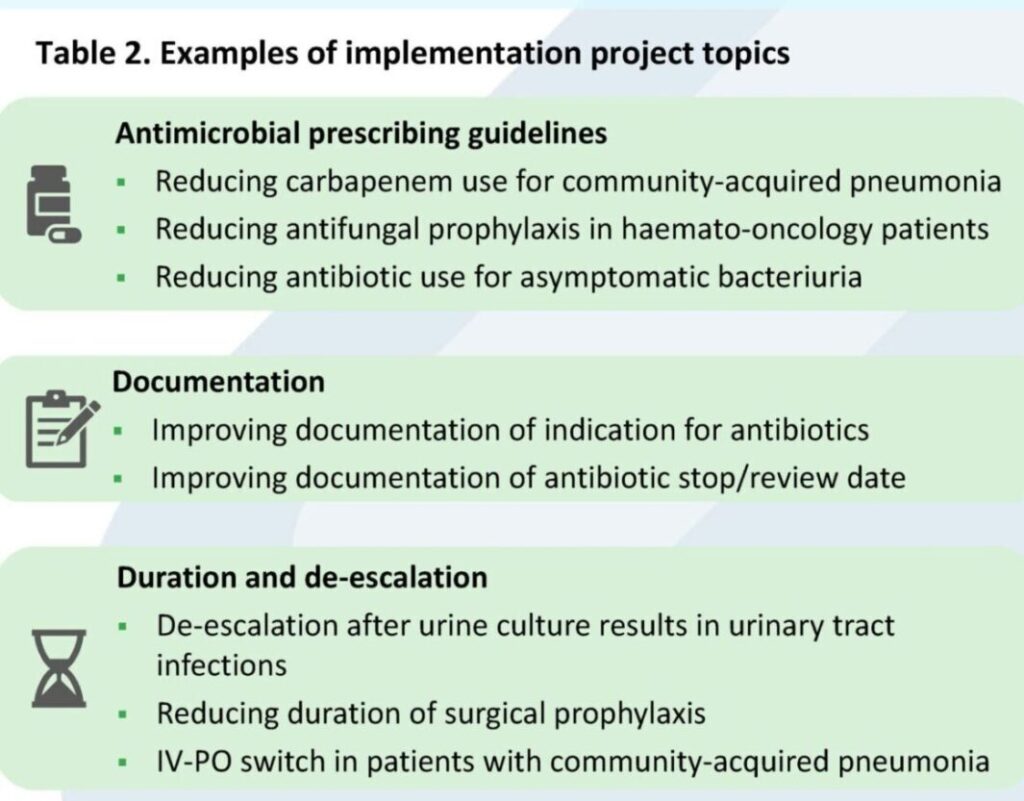
All participating hospitals developed AMS improvement projects, with topics ranging from optimizing antibiotic use for community-acquired pneumonia to improving microbiological sampling in suspected sepsis. By the end of 2024:

  • 83.7% of hospitals completed a post-course follow-up questionnaire
  • 24 hospitals had begun implementing their projects
  • 8 had conducted post-intervention measurements
  • 4 reported measurable improvements in prescribing
  • 5 had initiated follow-up projects

It is also very interesting to see that drive-AMS’s impact extends beyond hospitals, with initiatives contributing to national policy in Portugal (Sustainable Health Pact 2024–2030), postgraduate education, PhD research, and public awareness campaigns.

Looking ahead
The drive-AMS initiative has successfully laid the foundation for sustainable AMS capacity building in four countries. By combining data, education, and tailored support, the project is catalyzing culture change in antimicrobial use. Future phases will focus on measuring long-term outcomes and adapting the model to additional settings across Europe and beyond.

The full edition of the drive-AMS poster can be consulted via this link:
Ines Pauwels, Robin Janssen, Elias Iosifidis, Neda Milevska-Kostova, Mihaela Lupşe, José-Artur Paiva, Emmanuel Roilides, Teske Schoffelen, Rolanda Valinteliene, Ann Versporten, Erika Vlieghe, Jeroen Schouten: Implementation of hospital antimicrobial stewardship in Europe using a data-driven behaviour change approach: insights from the drive-AMS EU project